1
Foundation / Anti-Vibration Mount
Role
Carries the set and keeps vibration out of the structure
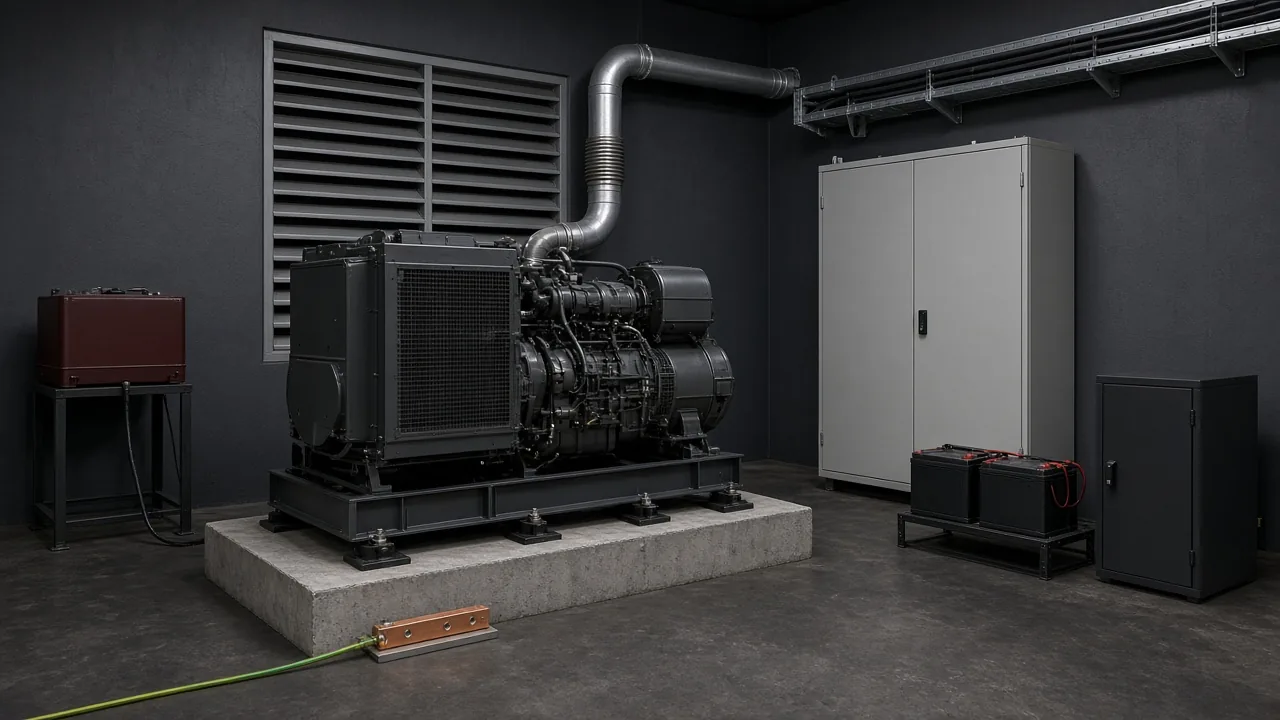
The base should sit level on a concrete plinth, with anti-vibration mounts between the frame and the concrete. In a tower, vibration that reaches the slab travels into the floors and also harms the set.
Site note
After transport, recheck plinth level and the mounts.
2
Generator Room / Ventilation
Role
Brings fresh air to the radiator and lets hot air out
Without enough inlet and outlet air the set overheats and loses power. Inlet and outlet must not short-circuit the airflow. In a tower this path is usually louvers and duct.
Site note
Size the louvers from that model’s radiator data.
Role
Moves the load between mains and generator
The automatic transfer switch moves the load to the generator when mains fails, then back after a delay when mains returns. The automatic mains failure controller starts and protects the set. Together they must block an unwanted parallel of mains and generator.
Site note
The mechanical or electrical interlock is not optional.
4
Power Cable / Control Cable
Role
Carries power and control signals to the building switchboard
Power-cable size comes from current, route length, and voltage drop. In a tower the route is usually a riser and cable tray. Keep control cables apart from power cables.
Site note
Use the site cable calculator for a first voltage-drop check.
Role
Takes exhaust outside, away from fresh air
The exhaust route must stay inside the engine’s allowed back pressure. A flexible joint near the engine keeps vibration out of the stack. The outlet must not sit by a window, an air inlet, or a walkway.
Site note
Do not run the set in a closed room without a designed exhaust route.
Role
Keeps running fuel and bulk storage separate
The day tank sits by the set. The bulk tank holds the main volume in a fuel room or outside. Transfer pump, vent, return line, and spill control belong to the same installation.
Site note
Drain water and sludge from the tank on a schedule.
Role
Connects frame and switchgear to a reliable earth
The generator frame, transfer panel, and cable tray should be bonded. Earth resistance is judged against the project standard, not one fixed number for every building.
Site note
Measure earth resistance after installation and keep the record.
8
Starter Battery / Battery Charger
Role
Cranks the engine and holds charge while the set waits
A standby set is off most of the time. A weak battery charger means it will not start on the day mains fails. Battery cables should be short, thick, and cleanly terminated.
Site note
Keep the scheduled test start in the maintenance plan.
Role
Holds sensitive loads until the generator is ready
The generator needs seconds to about a minute to reach rated speed and voltage. Servers, process controls, and some lifts ride through that gap only if a UPS sits ahead of the transfer switch. It does not replace the generator.
Site note
Size it from the sensitive load and the real start-up time of the set.